
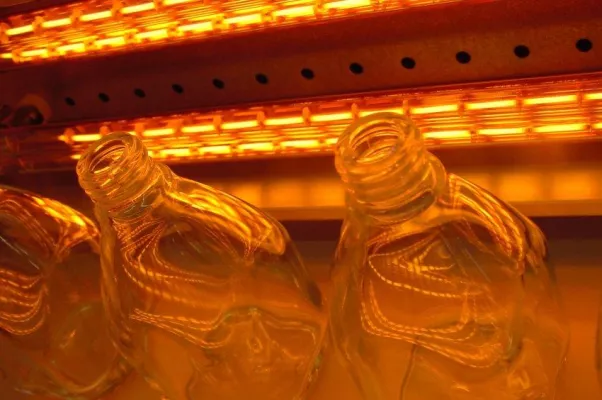
Getting the Heat Right for Glass Additives
Most quartz halogen emitters just throw energy out there in a big, broad wave. For a lot of jobs, that works just fine. But when you’re dealing with specific glass additives, things get tricky. The material only “wants” to absorb energy at certain peak wavelengths. If your lamp isn’t hitting those exact spots, you’re basically just wasting electricity. Worse, you end up with uneven heating or those annoying surface defects that ruin a batch. Hitting the Sweet Spot We don’t do “generic” here. We tweak the filament and add specific interference coatings to the quartz envelope to shift the spectrum. The goal is to hit the exact resonance of your additive. Instead of the heat just bouncing off the surface like a stone on a pond, it actually sinks in. It’s the difference between warming the skin and warming the core. The Trade-off (Because there’s always one) Here’s the catch: when you tune a lamp for a narrow band, you lose some raw power. A coated lamp isn’t going to put out as many BTUs as a clear tube. You’ll need to keep that in mind when you’re planning your heater bank. To make up for the dip in power, we usually bump up the filament density or tweak the voltage. It keeps the heat flux where it needs to be without sacrificing the precision. Real-World Setup The good news? These are drop-in replacements. You can wire them into your current controllers without moving a single bracket or changing your footprint. But a word of warning: don’t try to swap these out for generic bulbs. You’ll likely end up with “cold spots” or a melt that just isn’t right. Also, keep an eye on your cooling systems. Because these emitters concentrate heat so effectively, they can put more stress on your housing than a standard lamp. Keep things cool, and you’re golden.