
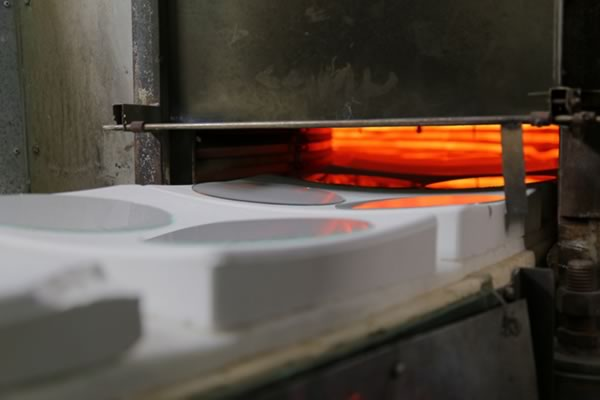
How a High-Power Infrared Halogen Lamp Gets Glass Ink Dry—In Seconds
We built our hydrophobic coating dryer around one workhorse: a high-efficiency infrared halogen heating lamp. Its whole reason for being? Making solvent vanish the instant the ink hits the glass—so you can handle and stack parts without them sticking together.
Power, voltage, and fit: why it dries so fast
This lamp was designed to pack a lot of heat into a small footprint. It runs on 400V, which lines up with standard industrial voltage. That means lower current on the wiring and less voltage drop over distance. At 2500W, it throws intense, directional infrared heat. And the 300mm tube length is matched to typical print-head widths. So the energy lands right where the wet ink comes out—and the surface layer flashes off in seconds.
What it’s made of—and why it stays steady shift after shift
The tube is quartz, because it handles high heat without blinking and transmits infrared beautifully. Inside, the halogen cycle keeps the filament stable at high temperature, so output stays consistent over long runs. The outside has a hydrophobic coating that shrugs off ink mist and dust. That means less downtime spent wiping the lamp clean. And the R7s two-pin connector? It’s straightforward to wire, and it locks the lamp in place so it stays perfectly aligned with the conveyor.
What this means on the line: no waiting, no sticking
On glass ink lines, the bottleneck is often drying—not printing. With this lamp, the printed surface dries in seconds, before the glass even reaches the stacker. The payoff is immediate: no transfer marks, and no blockage from fresh ink. Now, the trade-off is real—2500W produces serious heat. So your machine needs solid cooling and airflow to keep the ambient temperature in check and protect nearby components.
Easy to add, predictable to run
This setup slides right into a print line as a drop-in solution. You get drying you can count on, and throughput that stays steady.